By James Rickman
The long-term market for water infrastructure upgrade and rehabilitation remains strong with capital expenditure expected to grow from $25.2 billion in 2009 to $49.7 billion in 2016.
For example, renewable “GrayWater” — the stuff that drains from bathtubs, sinks and clothes washers — generates 40 gallons of water per person per day in the U.S. that could be recycled in the landscape or reused to flush toilets in addition to large volume commercial industrial needs.
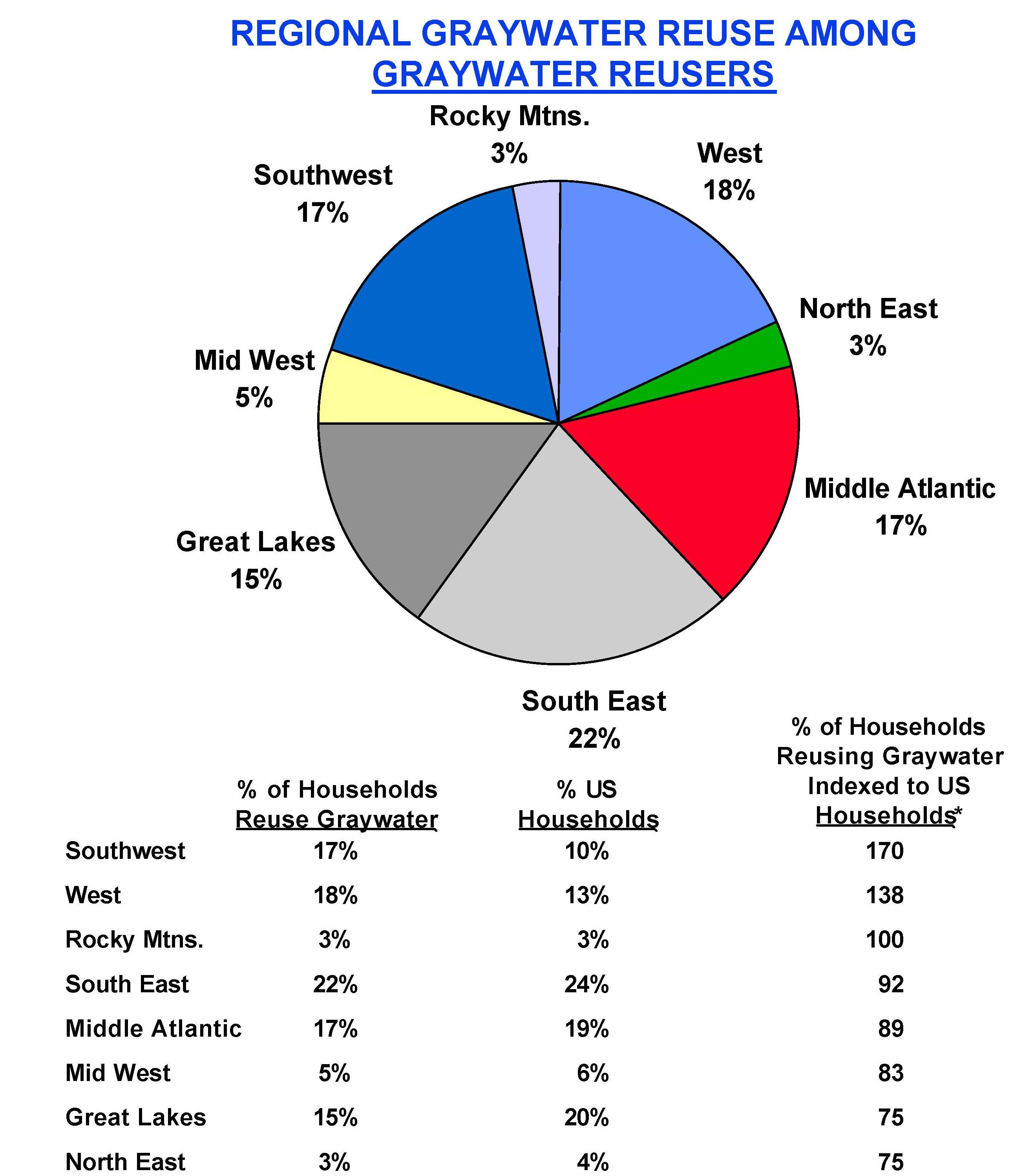
Today, only a relatively small portion just over 10% of the 98 million or so U.S. households currently reusing graywater. Although, I found on my recent visit to California’s wild horse ranch sanctuary Return To Freedom that in Santa Barbara County gray water recycling has grown to over 17% becoming an important sector.
For example, renewable “GrayWater” — the stuff that drains from bathtubs, sinks and clothes washers — generates 40 gallons of water per person per day in the U.S. that could be recycled in the landscape or reused to flush toilets in addition to large volume commercial industrial needs.
Today, only a relatively small portion just over 10% of the 98 million or so U.S. households currently reusing graywater. Although, I found on my recent visit to California’s wild horse ranch sanctuary Return To Freedom that in Santa Barbara County gray water recycling has grown to over 17% becoming an important sector.
Gray water can be defined as any wash water that has been used in the home, except water from toilets. Dish, shower, sink, and laundry water comprise 50-80% of residential "waste" water. This may be reused for other purposes, especially landscape irrigation.
What if you could shower and water the lawn at the same time. Maybe wash your clothes and irrigate the garden? If the average household recycled its gray water, it would cut total use by 25 percent, a boon for innovative states such as Oregon and California that often struggle to keep pace with growing demand.
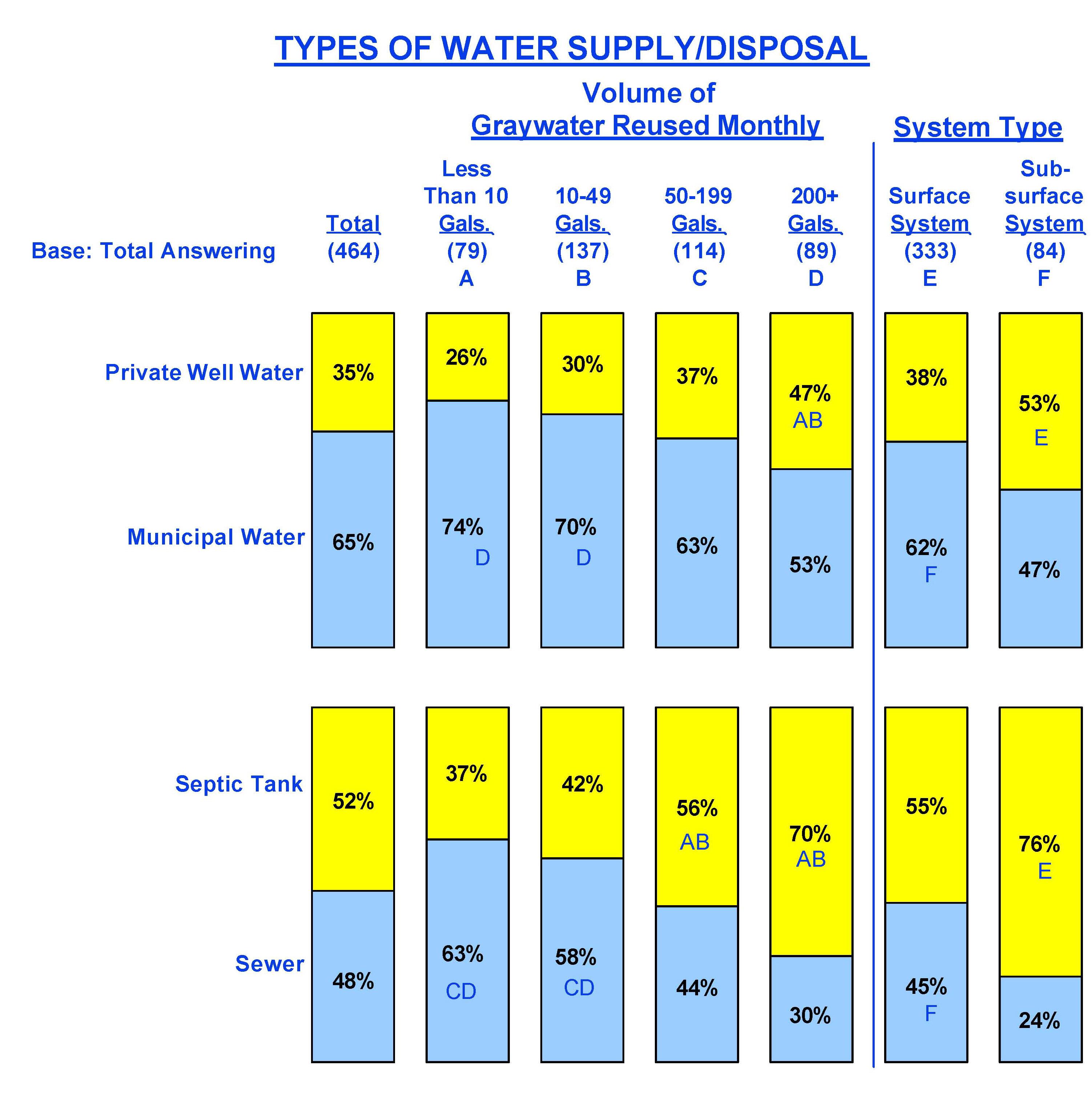
The nationwide regions that have the greatest concentration of graywater reuse are the Southwest and Western areas of the country. Graywater reusers tend to own a single-family house, have households sizes 4 or less and do not use mechanical water softener. High volume users are more likely to have private wells and septic tanks.
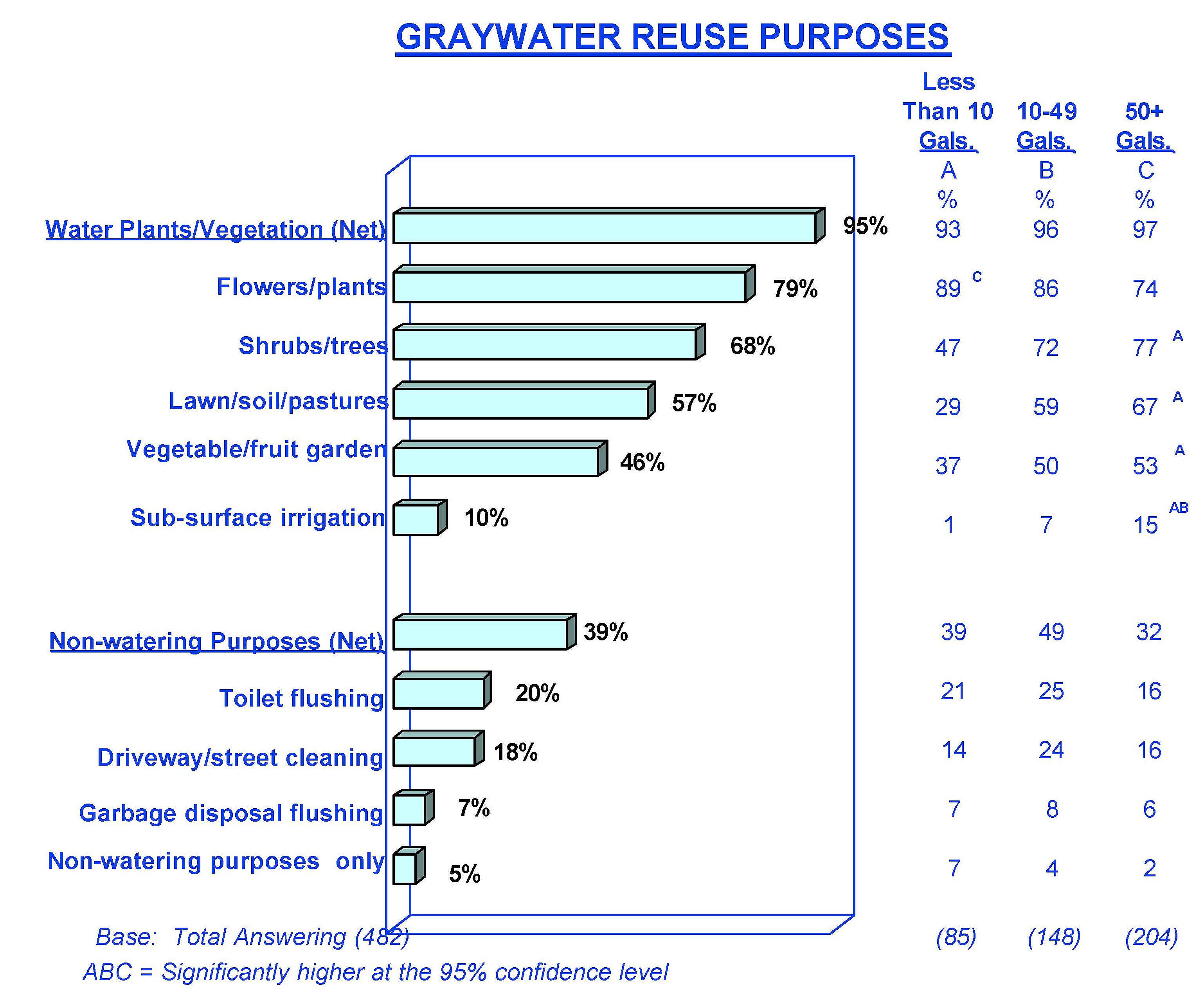
Less than a third of graywater reusers own a handling or treatment system for graywater. 93% of reusers are not treating the graywater before disposal. Over 70% of graywater reusers collect graywater before it enters the household plumbing system.
Is grey water reuse safe?
Yes. There are nine million greywater systems in the US with about 22 million users. In the past 60 years, there has been one billion system user-years of exposure, yet there has not been one documented case of greywater transmitted illness.
We see a growing trend with states such as; New Mexico, California, Oregon, Massachusetts, New Jersey, Arizona and a handful of other states are extending laws that promote gray water recycling to help conserve, but the practice is out of reach for most households in Oregon.
For example, the state of Oregon working with ReCode, an environmental group took its first steps recently during a legislative session to make gray water more accessible including efforts for a full-blown sewage treatment plant with a new law designed to simplify permits and expand the definition of gray water and its uses.
The Oregon Department of Environmental Quality also recently launched a gray water Web site and will soon lead an advisory committee to create gray water rules.
The new laws being implemented often define gray water as household water that isn't contaminated by toxins or human waste, which means toilets and washing machines with cloth diapers are off limits.
The gray water isn't drinkable, but it's safe to recycle for other uses. But Oregon residents can't divert their gray water just yet. It could take some time to fully establish widespread regulations and the permit process as outlined by the DEQ's Biosolids and Water Reuse Program.
Gray Water Stock Investments
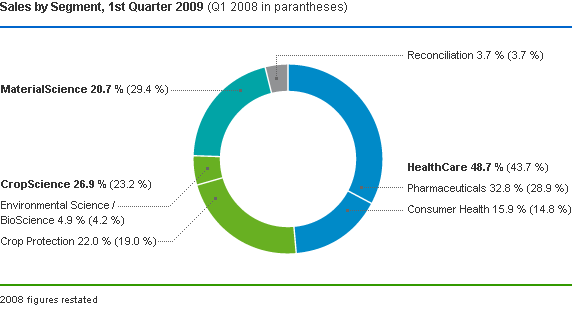
Investments into this consumer and commercial growth sector includes companies such as Solvay Group (SOLB.BB), Uhde a division of ThyssenKrupp Group, and Germany giant BAYER AG’s (BYERF.PK) Technology Group among leaders in graywater , waste water, microfilteration, ultrafilteration, osmosis, and chlorine electrolysis treatments. Note, the BAYER Q1 2009, sales chart below:
Among global leaders in graywater , waste water, microfilteration, ultrafilteration, osmosis, and chlorine electrolysis treatments is General Electric (GE) Water & Process Technology with hundreds of millions in capital developments, particularly within China and Singapore most notably. Other interestingly, participants are Insituform (INSU), Veolia Environnement SA (VE) and Fluor (FLR) for being best positioned in water infrastructure.
Why Does Greywater Matter?
Viewed narrowly, greywater systems don’t look that important. However, upon closer examination including for example; the recent California Drought Report, June 2009 and World Health Organizations Gray Water Report, 2009. Perhaps the efficiencies of “gray water usage” will continue to emerge as a significant sustainable growth sector.
For example, a low flow showerhead can save water with less effort. A septic system can treat greywater almost as well. But when you look at the whole picture—how everything connects—the keystone importance of greywater is revealed.
What if you could shower and water the lawn at the same time. Maybe wash your clothes and irrigate the garden? If the average household recycled its gray water, it would cut total use by 25 percent, a boon for innovative states such as Oregon and California that often struggle to keep pace with growing demand.
The nationwide regions that have the greatest concentration of graywater reuse are the Southwest and Western areas of the country. Graywater reusers tend to own a single-family house, have households sizes 4 or less and do not use mechanical water softener. High volume users are more likely to have private wells and septic tanks.
Less than a third of graywater reusers own a handling or treatment system for graywater. 93% of reusers are not treating the graywater before disposal. Over 70% of graywater reusers collect graywater before it enters the household plumbing system.
Is grey water reuse safe?
Yes. There are nine million greywater systems in the US with about 22 million users. In the past 60 years, there has been one billion system user-years of exposure, yet there has not been one documented case of greywater transmitted illness.
We see a growing trend with states such as; New Mexico, California, Oregon, Massachusetts, New Jersey, Arizona and a handful of other states are extending laws that promote gray water recycling to help conserve, but the practice is out of reach for most households in Oregon.
For example, the state of Oregon working with ReCode, an environmental group took its first steps recently during a legislative session to make gray water more accessible including efforts for a full-blown sewage treatment plant with a new law designed to simplify permits and expand the definition of gray water and its uses.
The Oregon Department of Environmental Quality also recently launched a gray water Web site and will soon lead an advisory committee to create gray water rules.
The new laws being implemented often define gray water as household water that isn't contaminated by toxins or human waste, which means toilets and washing machines with cloth diapers are off limits.
The gray water isn't drinkable, but it's safe to recycle for other uses. But Oregon residents can't divert their gray water just yet. It could take some time to fully establish widespread regulations and the permit process as outlined by the DEQ's Biosolids and Water Reuse Program.
Gray Water Stock Investments
Investments into this consumer and commercial growth sector includes companies such as Solvay Group (SOLB.BB), Uhde a division of ThyssenKrupp Group, and Germany giant BAYER AG’s (BYERF.PK) Technology Group among leaders in graywater , waste water, microfilteration, ultrafilteration, osmosis, and chlorine electrolysis treatments. Note, the BAYER Q1 2009, sales chart below:
Among global leaders in graywater , waste water, microfilteration, ultrafilteration, osmosis, and chlorine electrolysis treatments is General Electric (GE) Water & Process Technology with hundreds of millions in capital developments, particularly within China and Singapore most notably. Other interestingly, participants are Insituform (INSU), Veolia Environnement SA (VE) and Fluor (FLR) for being best positioned in water infrastructure.
Why Does Greywater Matter?
Viewed narrowly, greywater systems don’t look that important. However, upon closer examination including for example; the recent California Drought Report, June 2009 and World Health Organizations Gray Water Report, 2009. Perhaps the efficiencies of “gray water usage” will continue to emerge as a significant sustainable growth sector.
For example, a low flow showerhead can save water with less effort. A septic system can treat greywater almost as well. But when you look at the whole picture—how everything connects—the keystone importance of greywater is revealed.
Ecological systems design is about context, and integration between systems. The entirety of integrated, ecological design can be reduced to one sentence: do what's appropriate for the context.
Ecological systems—rainwater harvesting, runoff management, passive solar, composting toilets, edible landscaping—all of these are more context sensitive than their counterparts in conventional practice; that's most of what makes them more ecological systems are more context sensitive than any other manmade ecological system, and more connected to more other cost efficient systems.
Get the greywater just right, and you’ve got the whole package right—and that matters.
Many people and organizations instinctively recognize that greywater is the ideal test case for the transition to a new way of regulating and building that is appropriate to a post-peak resource, mature civilization.
Expect Growth
Capital expenditure on crucial water infrastructure projects in the U.S. has been cut back by 12.9% over the past few months due to restraints on borrowing, shrinking tax bases related to population issues and a drop in capital contributions from property developers.
However, the long-term market for water infrastructure upgrade and rehabilitation remains strong with capital expenditure expected to grow from $25.2 billion in 2009 to $49.7 billion in 2016. The largest area of investment will be in sewer network rehabilitation, which will attract a total of $46 billion over the next eight years. The fastest-growing market will be seawater desalination, which represented a comparatively small capital expenditure of $130 million in 2008 but, driven by major water shortages, will grow to more than $1 billion by 2015.
Review more details about the evolving water challenge worldwide in my recent article; "BLUE GOLD - Clean Water The Ultimate Commodity". To learn more about the evolving regional “gray water laws” visit the links below:
Arizona grey water law - the model to emulate
Uniform Plumbing Code
International Plumbing Code
California
Malibu, California
Connecticut
Colorado
Montana
Nevada
New Jersey
New Mexico
New York
Massachusetts
Oregon
Texas
Utah
Washington
Vermont
Australia
Jordan
For more sustainable marketing - copywriting information email sustainablevirtualteams@yahoo.com or call (503) 621-4953.